AI in Classrooms: The Gap No One Talks About

AI is no longer “the future”. It is already shaping how students think, create, and solve problems.
And yet, inside classrooms, a quieter reality is unfolding.
A gap.
Not of awareness.
Not of intent.
But of execution.
Everyone Agrees AI Matters. So, Why the Disconnect?
Schools understand the urgency. Teachers feel the pressure to keep pace. Students are more than ready. They are curious, adaptive, and eager to explore. And still, meaningful AI learning remains limited. Because introducing AI into education is not as simple as adding another subject to the timetable.
It demands something deeper, a shift in how learning itself is designed.
AI Is Not a Subject. It’s a Shift in Pedagogy
Most current approaches treat AI as content to be delivered. But AI doesn’t sit comfortably within traditional teaching models. It cannot be reduced to definitions, diagrams, or isolated lessons.
To truly engage with AI, students need to:
Build
Experiment
Question
Iterate
This requires moving:
From theory → to real-world application
From passive consumption → to active creation
From rigid instruction → to guided exploration
And that’s where the friction begins.
Where AI Initiatives Fall Short
The challenge is rarely intent. Schools invest in resources. Educators invest time and effort.
But without the right structure, AI becomes:
Too abstract for students
Too overwhelming for teachers
Too disconnected from classroom realities
What’s missing is not enthusiasm. It’s a clear, classroom-ready pathway.
One that answers:
What does AI learning look like day-to-day?
How do teachers facilitate it with confidence?
How do students move from understanding to building?
From Introduction to Integration
The real challenge is not introducing AI. It’s integrating it, seamlessly, into the fabric of learning.
In a way where:
AI does not feel like an “extra”
Lessons don’t feel forced or complex
Teachers feel supported, not stretched
Students engage naturally, without hesitation
When done right, AI doesn’t disrupt the classroom. It fits into it. Almost as if it was always meant to be there.
What the Shift Actually Looks Like
A meaningful AI classroom is not defined by tools or terminology. It is defined by experience.
Students are not just learning about AI. They are using it to solve problems, build solutions, and express ideas.
Teachers are not expected to become AI experts overnight. They are guided with structure, clarity, and practical pathways.
The focus moves from:
“Can we teach AI?”
to
“How do we make AI work within our classrooms?”
The Way Forward
AI in education is no longer a question of if. It is a question of how.
How do we make it accessible?
How do we make it practical?
How do we make it sustainable for teachers—and meaningful for students?
These are the questions that will define the next phase of education. And these are the conversations we need to be having now.
Continuing the Conversation
If you’ve ever wondered:
How to move beyond theory
What students can actually build
How to make AI work within your classroom context
This is a conversation worth being part of.
Because the future of AI in education won’t be shaped by intention alone. It will be shaped by how effectively we bring it into everyday learning.
Take the Next Step
Understanding the gap is one thing. Seeing what it looks like to solve it in real classrooms is another.
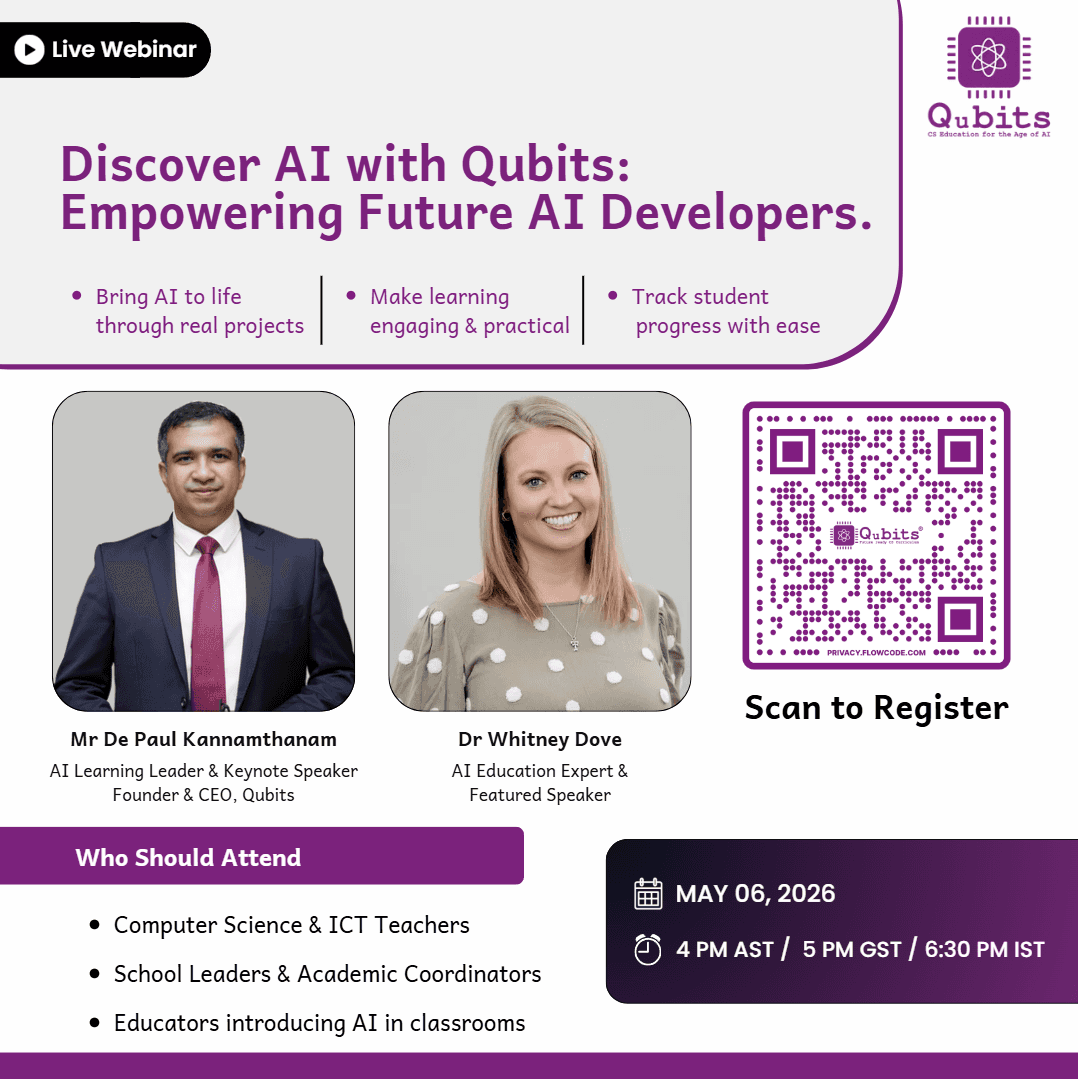
Join us for the session:
Discover AI with Qubits: Empowering Future AI Developers
In this live webinar, we’ll explore:
How AI can move from concept to real student creation
What it takes to build future-ready AI skills in classrooms
How teachers can guide students from learning AI → to building with it
Because empowering future AI developers doesn’t start with tools. It starts with how AI is experienced in the classroom.